

Object Record
Images
Metadata
Artist |
Fresnel |
Description |
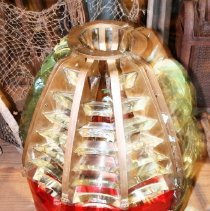
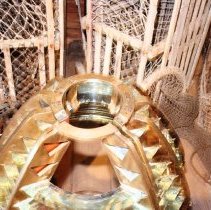
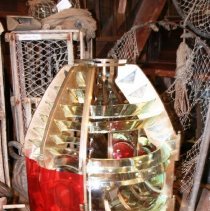
Sakonnet Light Fresnel Lens Lighthouses like Sakonnet Light have long kept sailors from wrecking on unseen rocks. In the eighteenth and nineteenth centuries when shipping was the lifeblood of commerce and travel, running aground was a serious and often deadly hazard. Early lighthouses relied on a simple flame provided by oil lamp or candle to warn impending ships, however, the light given off was so feeble that by the time the captain saw the lighthouse, it was often too late to change course. This changed with the invention of kerosene lamps and the Fresnel lens. Invented by French physicist Augustin-Jean Fresnel in the 1820s, the Fresnel lens has been dubbed "the invention that saved a million ships." The Sakonnet lighthouse, built in 1884, used a Fresnel lens to warn ships away from the Point’s rocky outcroppings. The lens could be made much thinner than a comparable conventional lens and deployed a large aperture and short focal length that projected light much stronger and at a farther distance. Fresnel lenses were classified into seven orders: first-order lenses were the largest and strongest, used for lighthouses along open oceans, while fourth-order lenses like this one were smaller and located along lakes and harbors. This light rotated on a clockwork mechanism and produced one white light with 3 red flashes every sixty seconds. Sakonnet Lighthouse sits on Little Cormorant Rock at the entrance to the Sakonnet River. One of its first keepers, Lucius E. Chadwick rowed out to the light on his first day on duty. Upon seeing the conditions on his new cold and rocky home, he promptly returned to the mainland and resigned. Clearly Sakonnet Light needed hardier keepers than Mr. Chadwick. One of its later keepers, Nils Nelson was awarded a gold lifesaving medal in 1903 after rescuing a man from drowning in a perilous attempt that could have dashed his own boat against the rocks. Though impaired, the light survived the Hurricane of 1938, continuing to light the mouth of the river until 1954, when Hurricane Carol severely damaged Sakonnet Lighthouse. The necessary repairs were deemed too expensive and the light was deactivated. The Coast Guard planned to demolish the station but the citizens of Little Compton fought for the preservation of the light. The light was maintained through public and private means until on March 19, 1997 Sakonnet Lighthouse was relighted as an active aid to navigation. Contributed by Katie Coggins Registrar's Notes: Revolving fourth-order Fresnel Lens producing one white light with 3 red flashes every sixty seconds for the Sakonnet Point Lighthouse in Little Compton, Rhode Island. The Fresnel lens was transfered to the Maine Lighthouse Museum. In the 1980s one section of the lens was loaned to the Little Compton Historical society to add to fund raising efforts for lighthouse maintenance and the remaining 3 section were loaned to the Little Compton Historical Society in 2011. |
Object Name |
Lens |
Catalog Number |
L2012.01 |
Date |
1884 |
Material |
Metal, glass |
Provenance |
Lens was removed from Sakonnet Lighthouse in 1954 and transfered to the Maine lighthouse Museum. One Section was loaned to the Little Compton Historical Society in 1987 and three more sections in 2011. |